


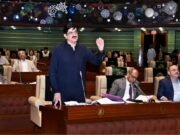















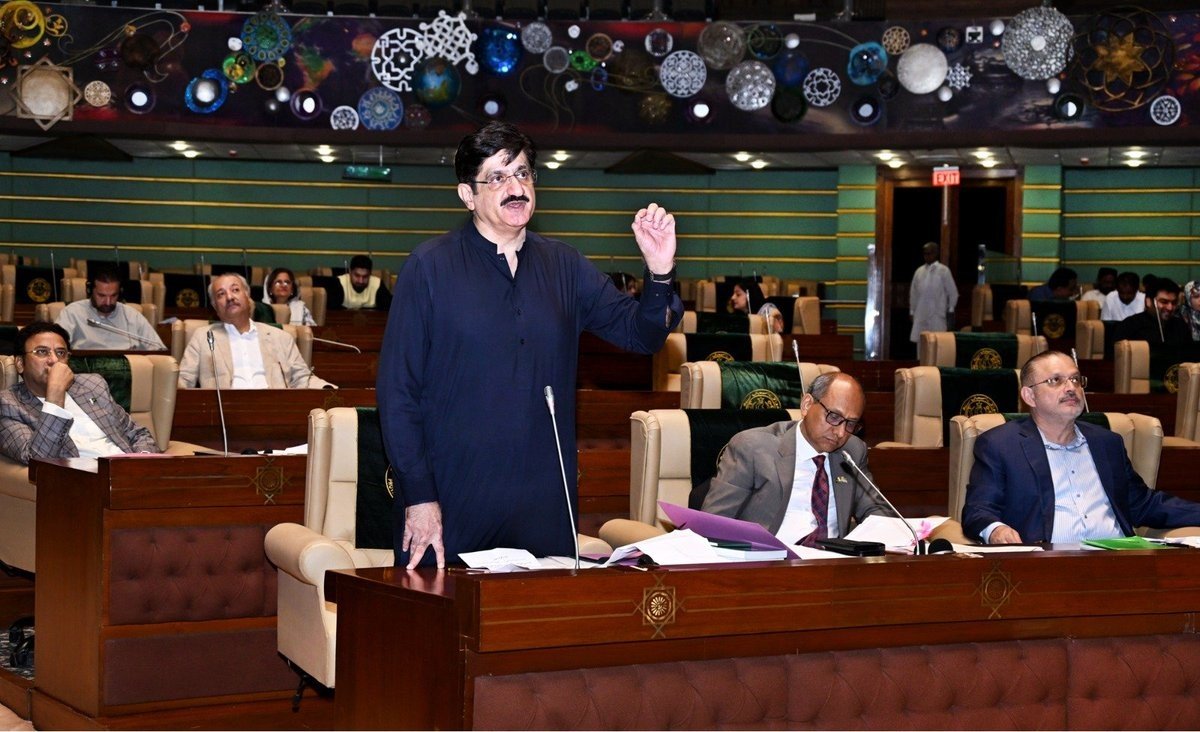
KARACHI: The Sindh Assembly on Sunday passed the Rs3.562 trillion budget for the 2026-27 financial year by a majority vote, rejecting around 1,600 cut motions moved by opposition members and approving Rs165 billion in supplementary grants.
The House also passed the Sindh Finance Bill, under which the provincial government imposed no new taxes, opting instead to rationalise the existing tax regime by revising selected tax rates and broadening the provincial tax base.
During the budget session, lawmakers from the opposition, including members of the Muttahida Qaumi Movement-Pakistan (MQM-P), Pakistan Tehreek-e-Insaf (PTI) and Jamaat-e-Islami (JI), challenged several budgetary allocations through cut motions, all of which were defeated due to the Pakistan Peoples Party’s (PPP) numerical majority in the House.
Among the rejected motions was an opposition proposal to withdraw funds allocated for the National Games. Chief Minister Syed Murad Ali Shah defended the allocation, after which the House voted against the motion.
Another cut motion targeted funding for the film Mera Lyari. Defending the project, the chief minister said Sindh was the first province to produce a film and argued that Mera Lyari projected a positive image of the province. The Assembly rejected the proposal.
The House also turned down an amendment to the Sindh Finance Bill moved by MQM-P lawmaker Sabir Qaimkhani, who sought to impose an 8% super tax on annual agricultural income of Rs50 million or more. Opposing the amendment, the chief minister argued that agricultural incomes generally did not reach such levels and noted that the federal government had also reduced the super tax on agricultural income.
Under the approved Finance Bill, the government retained the existing provision of an 8% super tax on agricultural income exceeding Rs500 million annually, while income below that threshold remains exempt. The legislation also revises rates for various provincial taxes and expands the tax net.
Earlier, winding up the seven-day budget debate, Chief Minister Murad Ali Shah described the Rs3.562 trillion budget as a document of “prudent financial discipline” aimed at positioning Sindh as a regional hub for trade, finance, renewable energy and investment.
He said the province had maintained fiscal discipline despite a Rs344 billion deficit, reduced federal fiscal space and over Rs95 billion in additional expenditures during the previous fiscal year.
The chief minister announced an Annual Development Programme (ADP) of Rs720 billion, including Rs206 billion earmarked for Karachi, with more than 1,800 development schemes planned across the province.
He said the government would pursue major initiatives including the development of Keti Bandar as a logistics hub through public-private partnership, the establishment of a Sindh International Financial Centre, expansion of renewable energy projects and an agricultural finance system for small farmers.
Murad Ali Shah also said allocations for education and health had been increased while administrative expenditure had been reduced by more than Rs62 billion to redirect resources toward development and public welfare.
Highlighting the Sindh People’s Housing Scheme, he said one million houses had been completed for flood-affected families while another 600,000 were under construction. He also noted that the World Bank had approved nearly $1.7 billion in financing for Sindh within the past two-and-a-half months.
The chief minister further highlighted progress on the Thar Coal project, the expansion of free cardiac care through the National Institute of Cardiovascular Diseases (NICVD), and the province’s growing renewable energy capacity.
Concluding the debate from the opposition benches, Leader of the Opposition Ali Khurshidi criticised the budget as a “collection of government claims and announcements” that failed to address the concerns of ordinary citizens. He questioned the government’s supplementary spending, alleged corruption in development projects, and demanded reforms in public institutions, including the Sindh Public Service Commission.
A total of 143 treasury and opposition lawmakers participated in the seven-day budget debate before the Assembly approved the budget, the Finance Bill and the supplementary grants. The session was later adjourned.