New Delhi: A youth-led protest demanding accountability over examination irregularities and the resignation of India’s Education Minister Dharmendra Pradhan continued in New Delhi on Tuesday, a day after clashes between demonstrators and police left scores injured and heightened political tensions.
The demonstrations, organised by the self-styled Cockroach Janta Party (CJP), have evolved from an online satirical movement into one of the largest youth-led protests in recent years, drawing support from students angered by repeated examination paper leaks, alleged corruption in the education system and limited employment opportunities.
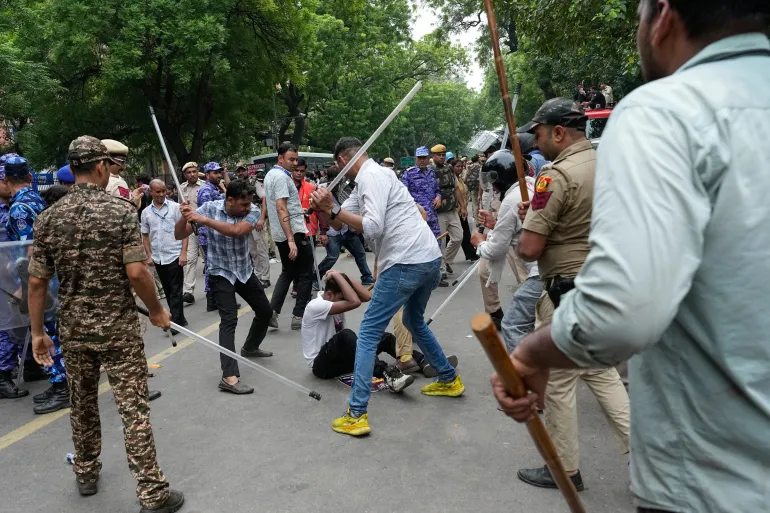
Thousands of students and young people gathered near Jantar Mantar on Monday in an attempt to march towards Parliament despite prohibitory orders and heavy security. Police used tear gas and baton charges to disperse the crowd after protesters breached barricades, triggering clashes that disrupted central Delhi.
Delhi Police said nearly 180 people were injured during the violence, including more than 118 police and security personnel and around 60 protesters. Seventy protesters were detained, and authorities said legal action would be initiated against those accused of violating restrictions. Police maintained that demonstrators displayed aggressive behaviour despite repeated warnings.
Protest organisers disputed the police’s account, accusing authorities of using excessive force against what they described as a peaceful march. CJP founder Abhijeet Dipke apologised to supporters injured in the clashes, particularly female protesters whom he alleged were beaten by male police officers.
Although the movement has called off further marches to Parliament to avoid additional injuries, it vowed to continue its sit-in protest at Jantar Mantar.
“We will not march again because the police will hurt the youth again,” Dipke told reporters, adding that the campaign would continue until its demands were addressed.
The protesters are demanding the resignation of Education Minister Dharmendra Pradhan over examination paper leaks and technical failures that have affected millions of students. They are also seeking broader reforms to improve transparency and accountability in India’s education and recruitment systems.
The protests gained momentum after education activist Sonam Wangchuk joined the campaign with an indefinite hunger strike on June 28. His fast ended after authorities shifted him to a hospital over the weekend. From hospital, Wangchuk said he would formally end his fast if the government accepted responsibility for failures in the examination system or lawmakers assured him they would address the protesters’ concerns.
The CJP has also demanded Wangchuk’s release and compensation for the families of students who reportedly died by suicide following the medical entrance examination controversy, according to local media reports cited by protest leaders.
The movement was sparked by a series of examination scandals, including the leak of question papers for a national medical entrance examination involving about 2.2 million candidates, which forced authorities to conduct a re-examination under heightened security. Another controversy involving technical problems in the online marking system for examinations taken by nearly two million high school students further fuelled public anger.
Despite India’s strong economic growth, many young people continue to express frustration over limited employment opportunities and concerns about fairness in competitive examinations. Government data shows unemployment remains significantly higher among people aged 15 to 29 than the national average, particularly in urban areas.
The government has begun engaging with protest leaders. Health Minister JP Nadda met two CJP representatives on Monday and agreed to discuss their demands within the government. Parliamentary Affairs Minister Kiren Rijiju also urged that ongoing discussions be allowed to continue without further escalation.
Prime Minister Narendra Modi did not address the protests in his remarks ahead of Parliament’s monsoon session, while opposition parties criticised the government’s handling of the demonstrations and demanded accountability for the police response.
Political analysts say that even if negotiations succeed in easing the immediate unrest, the widespread frustration among young Indians over education, employment and governance is likely to remain a significant challenge for the government in the months ahead.