


























By KDP News Political Desk | November 2025
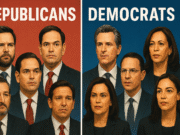
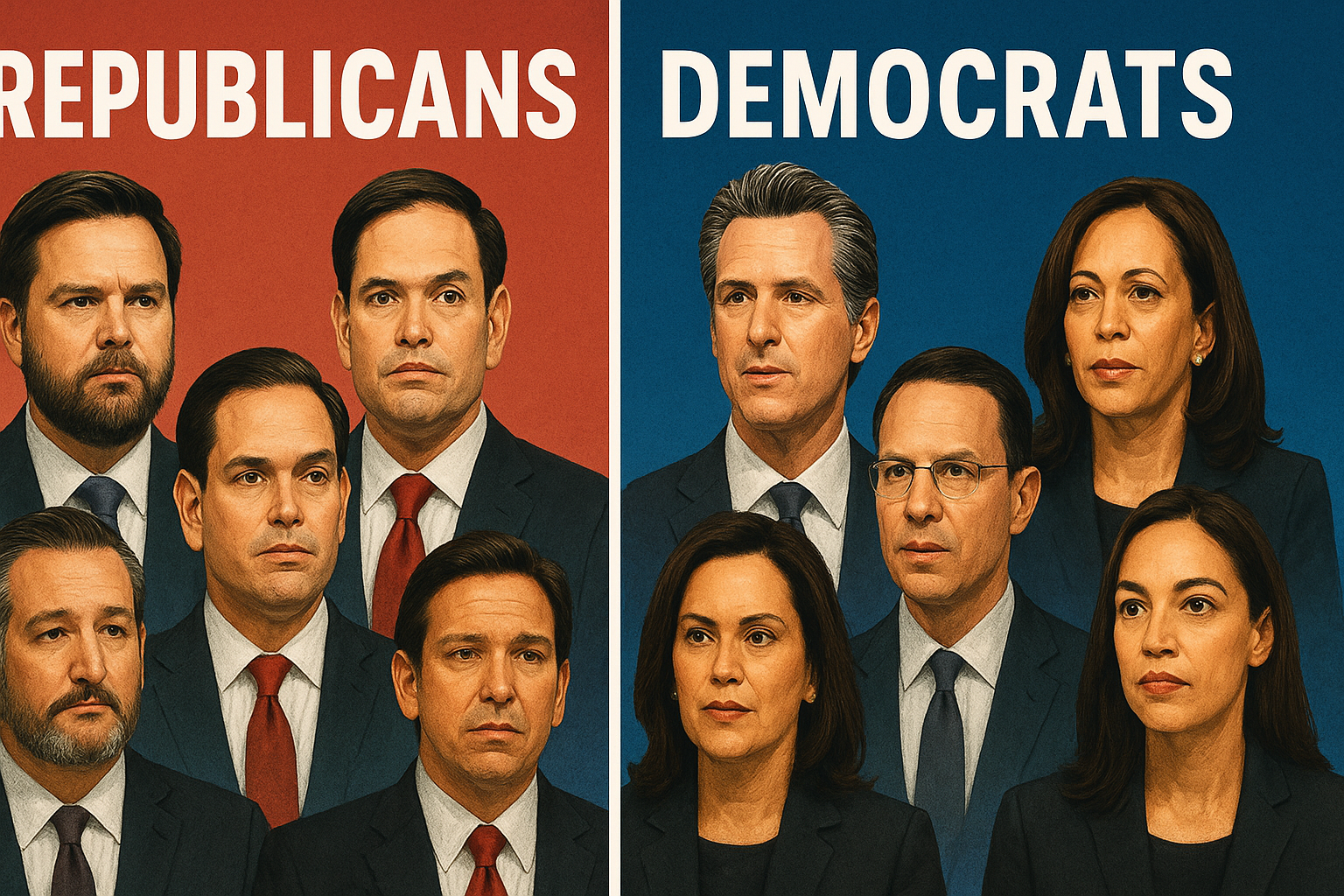
As President Donald Trump’s second term moves into its latter half, both Republicans and Democrats are quietly preparing for a post-Trump political era. The 2028 presidential race is already taking shape — and with the ideological identity of both parties at stake, the competition promises to be intense.
Republican Contenders: Who Will Inherit the MAGA Mantle?
JD Vance – The Loyal Successor
Vice President JD Vance is seen as the natural heir to the Trump movement. Since taking office, he has maintained strict alignment with Trump’s policies — from immigration and trade to foreign aid cuts — and has emerged as a leading voice defending the administration in Congress and the media.
Vance has championed a “working-class conservatism,” arguing that Republican priorities should focus on rebuilding American manufacturing and limiting corporate power. Critics say he’s yet to define himself beyond Trump’s shadow, but his unflinching loyalty to the MAGA base makes him a frontrunner in nearly every early poll.
Marco Rubio – The Diplomat of the Right
Serving as Trump’s Secretary of State, Marco Rubio has been central to major foreign policy moves — including the Iran strikes, reshaping Middle East alliances, and recalibrating aid to Ukraine and Israel.
Rubio advocates a “muscular but moral” American foreign policy, positioning himself as a bridge between traditional conservatives and the populist right. Though less visible domestically, he has won praise among establishment Republicans who see him as a stabilizing post-Trump figure capable of attracting moderates and international allies.
Donald Trump Jr. – The MAGA Heir
Donald Trump Jr. remains a powerful voice in conservative media and grassroots activism. Without holding public office, he has effectively become a spokesperson for the America First movement — emphasizing border security, cultural conservatism, and economic nationalism.
He argues that the Republican Party should “never return to the old ways of Washington,” signaling his intent to carry forward his father’s populist legacy. Strategists say he could either lead the ticket or play kingmaker in shaping the GOP field.
Ron DeSantis – The Conservative Strategist
After his 2024 presidential bid, Governor Ron DeSantis has re-emerged as a thought leader on conservative governance. His tenure in Florida has been marked by aggressive policies on education reform, parental rights, and corporate accountability, particularly against what he calls “woke capitalism.”
Although he clashed with Trump in 2024, DeSantis continues to attract conservative voters who want a disciplined, policy-driven version of MAGA politics. His challenge will be maintaining national relevance after his term ends in 2027.
Ted Cruz – The Constitutional Conservative
Senator Ted Cruz remains one of the intellectual heavyweights of the Republican Party. Once a fierce Trump rival, he has since aligned with the administration while still voicing skepticism on issues like tariffs and government overreach.
Cruz emphasizes constitutionalism, religious liberty, and free-market economics. His critique of federal censorship and government interference in private speech appeals to traditional conservatives who worry about the party’s populist turn.
Democratic Contenders: Searching for a New Vision
Gavin Newsom – The Progressive Counterweight
California Governor Gavin Newsom has positioned himself as the leading Democratic counterbalance to Trumpism. He has used California’s policies — on climate action, healthcare access, and immigration protection — as a model for a “modern progressive America.”
Known for his sharp social media exchanges with Trump allies, Newsom has built a national following. Democrats see him as an articulate defender of liberal values who can mobilize younger voters and the party’s activist base.
Kamala Harris – The Resilient Contender
After her tenure as vice president and her 2024 presidential campaign, Kamala Harris remains one of the party’s most visible figures. Her focus on criminal justice reform, reproductive rights, and voting access continues to resonate with progressives, while her foreign policy experience offers credibility with moderates.
Harris’s main challenge will be overcoming the perception that she struggled to define a strong leadership identity during her vice presidency — but her allies insist her experience makes her a natural frontrunner.
Josh Shapiro – The Centrist from Pennsylvania
Pennsylvania Governor Josh Shapiro represents the pragmatic wing of the Democratic Party. He has emphasized fiscal responsibility while championing reproductive rights, labor protections, and bipartisan governance.
His ability to win in a key swing state gives him national credibility, and his criticism of the far-left’s handling of issues like Israel and policing has drawn support from moderate Democrats seeking a unifying candidate.
Gretchen Whitmer – The Midwestern Moderate
Michigan’s Governor Gretchen Whitmer has gained prominence as a results-oriented Democrat who connects with both urban and rural voters. Her message centers on infrastructure, economic revitalization, and pragmatic governance.
Whitmer argues that Democrats must “show up everywhere,” often campaigning in deep-red districts to broaden the party’s reach. Many analysts see her as a potential dark horse who could consolidate working-class and suburban support.
Alexandria Ocasio-Cortez – The Progressive Firebrand
Congresswoman Alexandria Ocasio-Cortez remains the face of the progressive left. Her advocacy for the Green New Deal, Medicare for All, and corporate accountability has made her one of the most influential Democrats in Washington.
While some within the party view her as too radical for a general election, her ability to mobilize young and diverse voters is unmatched. Whether she seeks the presidency or a Senate seat, her influence will shape the Democratic platform for years to come.
The Bottom Line
The 2028 election may mark a generational shift in American politics. Republicans are debating how tightly to cling to Trump’s populism, while Democrats are weighing whether to move left or reclaim the center.
What’s clear is that both parties are already defining their futures — and the race to shape post-Trump America has quietly begun.